
Qblox Control Electronics Power the QUB on Open Quantum
The Qblox Cluster delivers the low-latency, high-channel-density control electronics at the heart of the Quantum Utility Block.
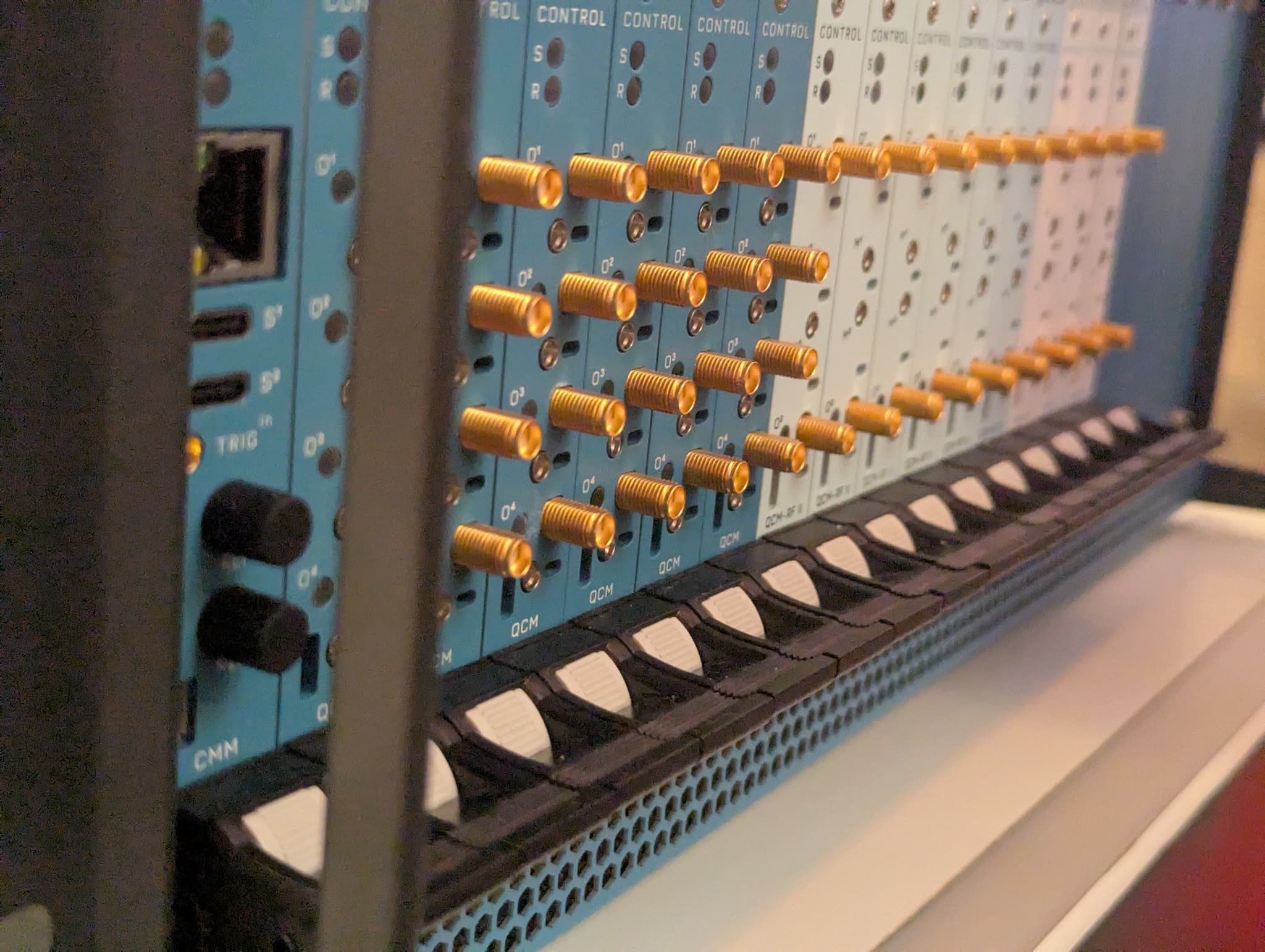
A Qblox Cluster control stack.
About Qblox
Qblox was founded out of Delft University of Technology and is currently headquartered in Delft, Netherlands. They engineer the electronic control stacks that make large-scale superconducting quantum computers practical.
Qblox hardware is deployed at leading quantum research institutions across Europe and North America, and is the designated control electronics layer in the Quantum Utility Block (QUB) architecture.
Qblox Cluster
Modular, rack-mountable control stack that scales channel density as qubit counts grow.
Q1 Pulse Processor
Custom FPGA-based sequencer that executes pulse programs in real time with sub-nanosecond timing accuracy.
Qblox in the Quantum Utility Block
The Quantum Utility Block (QUB) is a pre-validated, on-premises quantum computer jointly engineered by Quantware, Qblox, and Q-CTRL. The stack consists of three interoperable layers: a QuantWare superconducting QPU, Qblox control electronics, and Q-CTRL's Boulder Opal autonomous software. Together they form an upgradable, operationally ready system, brought online as a cloud service by Open Quantum.
Every quantum computer requires a precise electronic control layer to translate gate-level instructions into the microwave pulses that manipulate physical qubits. Qblox provides these electronics. The Cluster is a modular, rack-mountable control stack that sits between the software and hardware layers, translating calibrated pulse schedules into microwave signals. The Q1 pulse processor, a custom FPGA-based sequencer within the Cluster, executes pulse programs in real time with sub-nanosecond timing accuracy.
On Open Quantum, this control layer is more than an implementation detail. You can submit standard OpenQASM circuits and let the stack handle the translation, or get closer to the metal by submitting Qblox sequences directly, programming the Q1 pulse processor with Q1ASM. Both paths run through the same Open Quantum API.
The QUB Stack
Cloud Layer
Open Quantum QaaS, unified API and job scheduling
Software Layer
Q-CTRL Boulder Opal software
Control Layer
Qblox Cluster electronics + Q1 pulse processor
QPU Layer
QuantWare superconducting QPU
Why It Matters on Open Quantum
Real Superconducting Hardware
Run circuits on a genuine superconducting QPU, not a simulator.
Pre-Validated Stack
The QUB arrives as a jointly validated system from QuantWare, Qblox, and Q-CTRL. Open Quantum adds the cloud layer without disrupting the validated hardware-software stack.
Cloud Access in Days
Open Quantum is the drop-in QaaS layer for a QUB system. A QUB deployment goes from on-premises hardware to cloud-accessible endpoint in a day, with no integration work.
Unified API
Submit circuits to a QUB using the same Open Quantum SDK and API you use for any other backend. $50 of free compute is included with every new account.
“We're proud to deliver this first-of-its-kind U.S.-based qubitlab with our partners.”
Frequently Asked Questions
Getting Started
Open Quantum already integrates the Qblox control stack. Sign up for a free account, receive $50 of quantum compute credits, and submit jobs to Qblox-controlled systems — including the Elevate Quantum Q-PAC — through the same unified API used for every backend on the platform. No vendor-specific setup required.
$50 of Free Quantum Compute
Every new Open Quantum account includes $50 of free quantum compute credits, refreshed every 90 days. Run circuits on Qblox-controlled systems, compare results across backends, and explore the Quantum Utility Block stack at no cost.
Explore Our Other Partners
qBitTensor Labs
Decentralized quantum-compute network
qBitTensor Labs operates the decentralized quantum-compute network on Bittensor Subnet 48, coordinating independent QPU operators so Open Quantum can offer real hardware at roughly half the cost, free to start.
Learn moreQ-CTRL
Quantum control software
Boulder Opal handles autonomous calibration, characterization, and error suppression, so a QUB system runs at high fidelity without a team of PhDs tuning gates by hand.
Learn moreQuantWare
Superconducting QPU hardware
QuantWare builds the high-coherence superconducting QPUs — including the Contralto-A and Contralto-D processors — with a VIO scaling path from tens to thousands of qubits.
Learn moreMaybell Quantum
Quantum cryogenics & infrastructure
Denver-built dilution refrigerators and the ColdCloud platform. Open Quantum connects to Maybell telemetry so you can monitor your fridge from anywhere alongside running jobs.
Learn moreElevate Quantum
Federal Quantum Tech Hub
A federally designated Quantum Tech Hub across Colorado, New Mexico, and Wyoming. Quantum Rings is a consortium member, and Open Quantum brings its Q-PAC system online for cloud access.
Learn more